 Save
Month-end close repeats twelve times. Year-end adds the work that only happens once, and it lands on every client in the same few weeks.
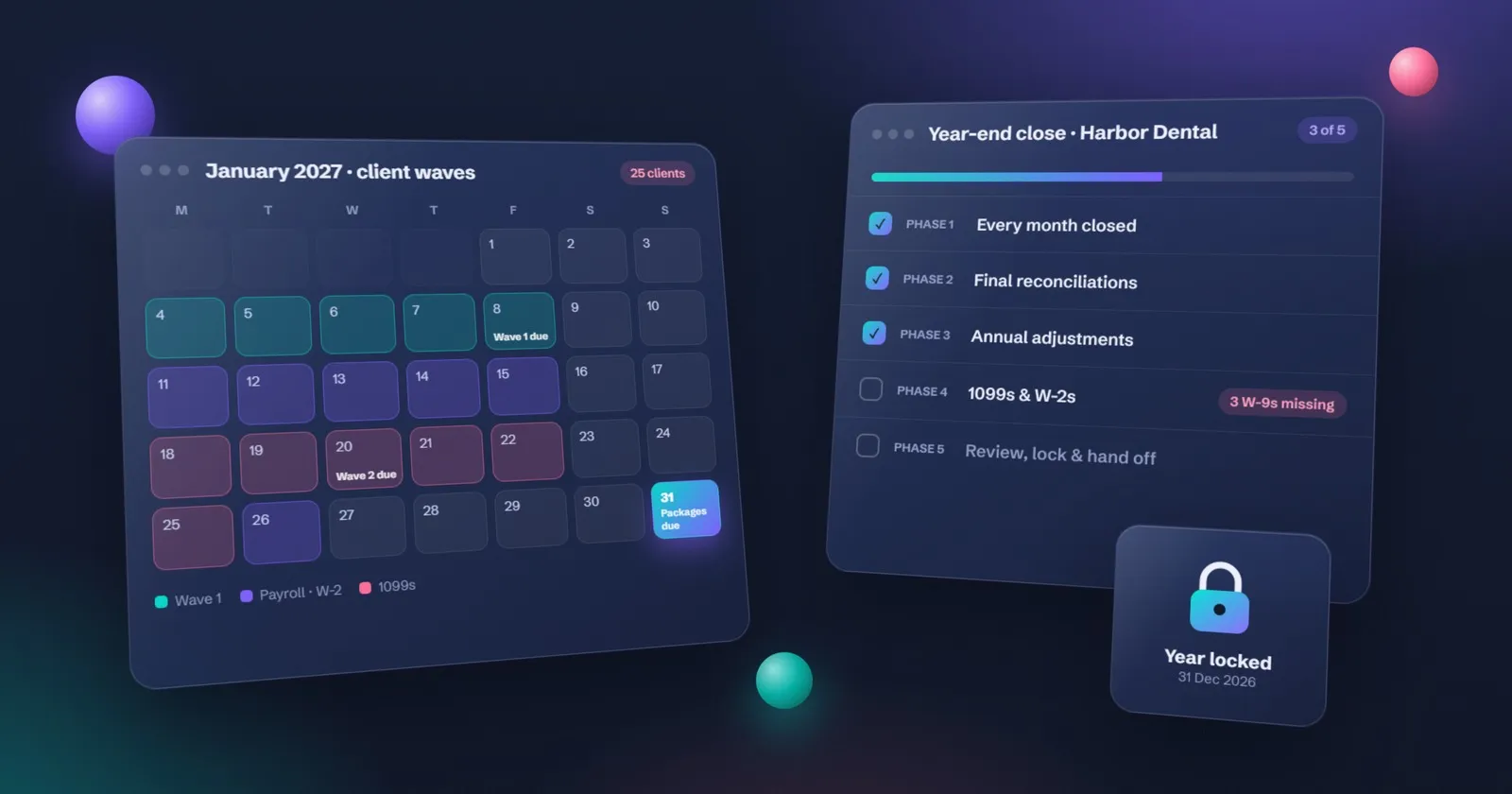
Take a made-up client, Harbor Dental. December year-end, two bank accounts, two credit cards, three contractors without W-9s, and a tax preparer who wants the package by 31 January. Multiply that by 25 clients and you can see why this checklist starts in November, not after the Christmas break.
Last updated 10 November 2026.
What a year-end close is
A year-end accounting close finishes every month of the fiscal year, reconciles balance sheet accounts through the year-end date, posts approved annual adjustments, prepares payroll and contractor reporting, and hands a locked package to the tax preparer. Bookkeepers who serve many clients also stagger due dates and track open client requests.
How year-end differs from month-end
If you already run the month-end close checklist, you’ve done most of the year-end work eleven times. December’s close is the same list with four additions:
- Assets and stock: depreciation, fixed asset additions and disposals, an inventory count.
- Owner and equity: draws, contributions, shareholder loans, personal expenses moved out.
- People reporting: W-2s and 1099s in the US, T4s in Canada, STP finalisation in Australia.
- A package for someone else: the tax preparer reads your work, so it needs to be complete without you in the room.
And one thing changes completely: you lock the year, not just the month.
The five phases of a year-end close
Here’s the year-end closing accounting checklist, phase by phase. The owner is the bookkeeper unless the line says otherwise.
| # | Task | Owner | Evidence |
|---|---|---|---|
| 1 | Confirm the client’s fiscal year-end date | Bookkeeper | Engagement letter or last return |
| 2 | Every month reconciled and reviewed | Bookkeeper | Month-end sign-offs |
| 3 | Opening balances tie to last year’s final package | Bookkeeper | Prior-year trial balance |
| 4 | Bank, card and loan accounts reconciled to year-end statements | Bookkeeper | Statements and reconciliation reports |
| 5 | Payroll accounts tie to payroll filings | Bookkeeper | Payroll summary |
| 6 | Depreciation and asset changes posted | Bookkeeper, approved by accountant | Fixed asset register |
| 7 | 1099 and W-2 totals reconciled | Bookkeeper | Vendor and payroll reports |
| 8 | Year locked and package delivered | Bookkeeper, signed off by owner or partner | Closing date set, package link |
Phase 1: Confirm every month is closed
Check the year-end date first. Not every client is on a calendar year, and getting this wrong is how a June year-end ends up in your January pile. Then confirm each month was reconciled and reviewed, opening balances tie to last year’s package, and the engagement letter actually covers year-end and tax-prep support. If it doesn’t, have that conversation now, before the work.
Phase 2: Final reconciliations
Reconcile to the year-end statement, not the feed:
- Bank, credit card, loan and line-of-credit accounts.
- Payment processors (Stripe, Square, PayPal) and any clearing accounts that should be zero.
- Receivables and payables subledgers to the general ledger.
- Payroll liability accounts to the filings.
- Sales tax, GST/HST or VAT accounts to the returns filed.
- The fixed asset register to the ledger.
Loans are the ones people skip. The lender’s year-end statement splits interest from principal, and that split is almost never right in the books until you fix it.
Phase 3: Annual adjustments
These need a person’s judgment, and usually the client’s answer:
- Depreciation and amortisation.
- Accruals and prepaid expenses.
- Inventory counted at cost.
- Bad debts, decided with the client.
- Owner draws, contributions and shareholder loans.
- Deferred revenue true-ups.
- Personal expenses moved out of the business.
Write every adjustment into a list with a one-line reason. The tax preparer will ask.
Phase 4: Tax and information returns prep
US rows here. Other countries are in the table further down.
- W-9s on file for every contractor you’ll report. Harbor Dental’s three missing W-9s go on the chase list today, not in January.
- 1099-NEC and 1099-MISC totals reconciled to vendor payments. For payments made in 2026, the IRS reporting threshold for nonemployee compensation is $2,000. It was $600 for payments made before 2026. (IRS: Am I required to file a Form 1099.)
- 1099-NEC due date: the rule is 31 January, for both the IRS copy and the recipient copy. In 2027 that falls on a Sunday, so the IRS weekend rule moves it to 1 February 2027. Aim for January anyway (Instructions for Forms 1099-MISC and 1099-NEC).
- W-2 totals reconciled to payroll. 2026 Forms W-2 go to the SSA and employees by 1 February 2027, because 31 January falls on a Sunday (General Instructions for Forms W-2 and W-3).
- Book-to-tax notes started: meals, vehicle use, anything the preparer will treat differently.
- Tax-prep folder assembled.
The $2,000 change is the trap this year. Your 1099 vendor list from last year was built on $600. Rerun it.
Phase 5: Review, lock and hand off
Pull the trial balance, profit and loss and balance sheet. Compare them with last year line by line and explain anything that moved more than you’d expect. Get a second review if your firm has one, then the owner’s or partner’s sign-off.
Then lock the year in the accounting file and deliver the package. Log anything still open with a name and a date next to it.
Free year-end checklist template
The template is the five-phase list above with a row per task, copied once per client. Use these columns in Excel or Google Sheets:
| Column | What goes in it |
|---|---|
| Client | One tab or block per client |
| Task | The checklist line |
| Owner | Who does it |
| Due date | Staggered per client (see below) |
| Evidence | Link to the report, statement or note |
| Status | Not started, waiting on client, done |
| Open question | What you’re waiting for, in plain words |
The “waiting on client” status does most of the work. Filter on it every Monday and you have your chase list. For the document requests themselves, the free document request checklist and the client onboarding tracker (our own product) do the same job with reminders built in.
Staggering 20 client year-ends without missing January
The mistake is giving every client the same deadline. Twenty files due on 20 January means twenty files untouched until 10 January.
Split them into waves instead:
| Wave | Clients | Phases 1–2 done by | Package delivered by |
|---|---|---|---|
| 1 | Simple files, quick responders | 15 December | 10 January |
| 2 | Payroll clients (W-2s) | 5 January | 20 January |
| 3 | Contractor-heavy clients (1099s) | 5 January | 25 January |
| 4 | Late responders, inventory, complex | 10 January | 31 January |
Send the year-end document request in mid-November for everyone. The responses tell you who belongs in wave 4. If January already overlaps with tax season in your firm, the tax season checklist shows how to plan capacity, and stop chasing clients for documents covers the chasing.
Country notes: US, Canada, UK and Australia
Check the due dates on the official site for the year you’re closing. Don’t apply one country’s calendar to another.
| Country | Year-end timing | Add to the checklist | Where to check |
|---|---|---|---|
| US | Mostly 31 December | 1099-NEC ($2,000 threshold for 2026 payments, due 1 Feb 2027 because 31 Jan is a Sunday), W-2 (due 1 Feb 2027), sales tax returns | IRS information returns |
| Canada | Any month for corporations | T4 slips and payroll remittances, GST/HST reconciliation, shareholder loan review | CRA pages on canada.ca |
| UK | Company year-end can be any month; personal tax year ends 5 April | VAT return timing, director’s loan account, accountant prepares CT600 | GOV.UK |
| Australia | 30 June for most | STP finalisation, BAS reconciliation, superannuation | ato.gov.au |
The UK row catches people out. A company’s year-end and the personal tax year (6 April to 5 April) are separate calendars, and a director client has both.
QuickBooks Online year-end notes
In QuickBooks Online, the year-end close is mostly the same reconciliation work, then setting a closing date with a password so nobody edits a closed period without it. The setting sits in the advanced account settings. Intuit moves menus around, so check its current help page for the exact labels. Xero does the same with a lock date under financial settings.
There’s no “close the year” button that does the work for you. Retained earnings roll forward automatically; everything else is the checklist.
Where AI helps (and where a person decides)
AI is good at the words around year-end. It drafts the “we still need your W-9s” email, summarises what each client still owes you, and turns a 30-minute call into a list of open questions. Our main pick is Grok Bot (setup guide). ChatGPT, Claude and Copilot do the same, and AI prompts for accountants has ready-made chase-email prompts.
What AI doesn’t do: post adjusting entries, decide a bad debt, or lock the year. A person reviews every journal. If you’re curious about AI coding transactions during the year, AI bookkeeping covers what works and what still needs checking.
If you’d rather run year-end in software than a sheet, practice tools such as Jetpack Workflow, Karbon and Financial Cents have recurring year-end jobs; the practice management software guide compares them. To collect the year-end documents securely, see the client portal guide.
More checklists for bookkeepers are on the tax firms hub.
Questions
What is a year-end accounting checklist?
It is the list of tasks that finishes a client's financial year: final reconciliations, annual adjustments, payroll and contractor reporting, review, locking the year and handing a package to the tax preparer. A good one also records who did each task and where the evidence is.
What is the difference between month-end and year-end close?
Month-end close repeats twelve times and makes one month reliable. Year-end close includes the twelfth month-end plus work that only happens once a year: depreciation, inventory, 1099s and W-2s, owner equity, and a package for the tax preparer.
What should be in a year-end package for the tax preparer?
A final trial balance, profit and loss, balance sheet, bank and loan reconciliations at year-end, a fixed asset schedule, payroll and 1099 summaries, a list of adjustments posted, and a short list of open questions or book-to-tax notes.
How do you do year-end close in QuickBooks Online?
Reconcile every account to the year-end date, post adjustments, review the reports, then set a closing date with a password in the advanced settings so earlier periods cannot change without it. Menu labels change, so check QuickBooks' current help page.
Is there a year-end accounting checklist template in Excel?
Yes. Build one with a row per task and columns for client, task, owner, due date, evidence, status and open question. It works in Excel or Google Sheets, and you copy the tab once per client.
What is a year-end checklist for bookkeepers?
It is a year-end close checklist written for someone closing many client files at once. It adds staggered due dates, a chase list per client and a status board, on top of the usual close tasks.
What changes for Canadian year-end bookkeeping?
Canadian files add T4 slips and payroll remittance checks, GST/HST reconciliations, and a shareholder loan review for incorporated clients. Check the CRA's current pages for due dates before you plan the calendar.
When is the end of the financial year in Australia?
For most Australian businesses the financial year ends on 30 June, so EOFY work peaks in June and July rather than December and January.
Can AI help with year-end close?
Yes, with the writing: drafting chase emails, summarising what a client still owes you, and turning call notes into a question list. A person still posts adjusting entries, signs off and locks the year.
This guide covers running the practice, not tax law. Rules differ by country and change often, so check anything technical with your local tax authority or professional body.